When Vision Outruns Leadership Capacity
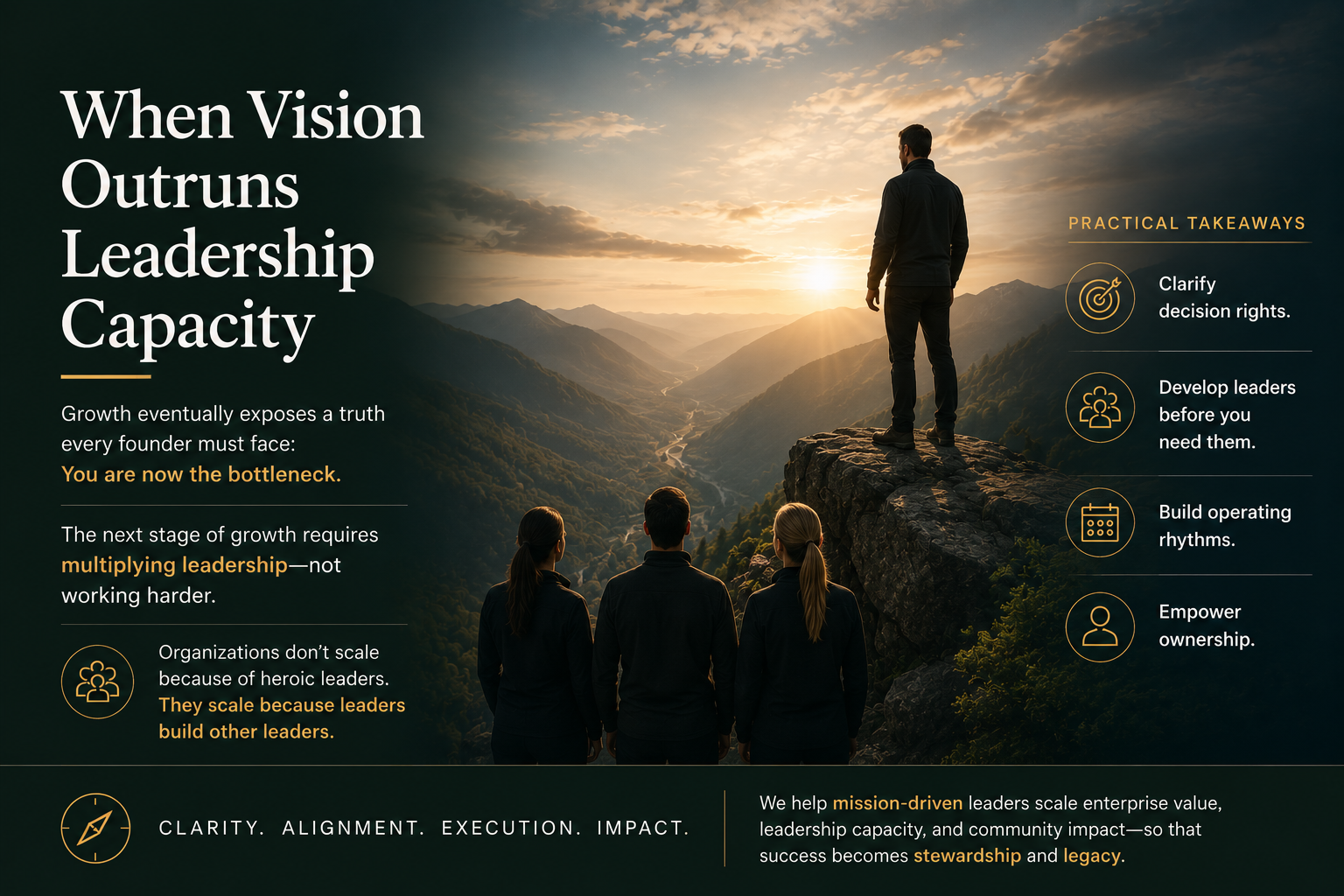
Growth doesn’t stall because your vision is too small. It stalls because your leadership capacity hasn’t caught up.
One of the defining moments in every founder’s journey isn’t landing the first customer, hiring the first employee, or crossing the first million dollars in revenue.
It’s the moment you realize you can no longer carry the organization on your own.
At first, that’s exactly what makes a founder successful. You make every important decision. You know every client. You solve every problem. You cast the vision. You protect the culture. You keep the wheels turning.
In the early days, that level of involvement isn’t a weakness—it’s a necessity. But what creates momentum in one season becomes the constraint in the next.
Vision Is Meant to Outgrow You
Every healthy organization reaches a point where its vision becomes larger than any one leader’s capacity.
That’s not failure. That’s growth.
The danger comes when founders mistake indispensability for leadership. I’ve worked with leaders who sincerely believed they were serving their organization by staying involved in everything.
In reality, they had become the largest obstacle to the very future they were trying to build. Every important decision waited on them. Every difficult conversation passed through them. Every relationship depended on them. Every problem landed on their desk.
The organization wasn’t scaling. It was simply stretching one person thinner.
Eventually, everyone feels it. The team waits instead of leading. Meetings replace momentum.
Good people lose confidence because they aren’t trusted to make meaningful decisions. The founder becomes exhausted. Not because the vision is too ambitious. Because the leadership model no longer fits the organization's size.
Leadership Is Not About Being Needed
Many founders secretly believe that if they’re no longer needed everywhere, they’re becoming less valuable.
The opposite is true. Your greatest contribution isn’t making every decision. It’s building leaders who can make wise decisions without you. Leadership isn’t measured by how many people depend on you. It’s measured by how many people become capable because of you. Organizations that create lasting impact aren’t built around heroic leaders.
They’re built around leaders who intentionally multiply other leaders. That shift requires humility. It requires trust. And it requires the discipline to develop people before growth demands it.
Four Shifts That Multiply Leadership
As organizations grow, founders must intentionally move from being the primary operator to becoming the chief architect of leadership.
Four shifts that make that possible.
1. Clarify Decision Rights
Confusion creates dependence.
People don’t hesitate because they’re incapable.
They hesitate because they’re unsure where authority begins and ends.
Define who owns what.
Empower leaders to make decisions within clear boundaries.
Clarity creates confidence.
2. Develop Leaders Before You Need Them
Too many organizations wait until they’re overwhelmed before investing in leadership.
By then, they’re already behind.
Leadership development isn’t a response to growth.
It’s what prepares an organization to grow.
Every leader should be developing someone who can eventually carry greater responsibility than they do today.
3. Build Operating Rhythms
Healthy organizations don’t depend on constant intervention.
They depend on consistent rhythms.
Regular leadership meetings.
Clear priorities.
Simple scorecards.
Healthy accountability.
Disciplined communication.
These rhythms reduce friction and create alignment without requiring the founder to orchestrate every detail.
4. Empower Ownership
Delegation transfers tasks.
Ownership transfers responsibility.
When people understand the mission, know the desired outcomes, and are trusted to lead, they stop waiting for permission and start creating momentum.
Ownership changes culture.
The Highest Return on Investment
Founders often ask where they should invest next.
Technology? Marketing? Sales? Operations?
All of those matter.
But few investments produce greater long-term returns than multiplying leadership.
Strong leaders create healthy teams. Healthy teams build resilient organizations.
Resilient organizations create enduring enterprise value and lasting community impact.
That’s the kind of growth worth pursuing.
A Question Worth Asking
If you stepped away from your organization for the next 90 days, what would happen?
Would decisions continue to be made?
Would culture remain healthy?
Would momentum continue?
Or would the organization pause until you returned?
Your answer isn’t a measure of your importance. It’s a measure of your leadership architecture.
Final Thought
Leadership is not about building an organization that cannot function without you. It’s about building one that flourishes because of the leaders you’ve developed.
Your vision deserves more than your personal effort. It deserves a leadership team capable of carrying it farther than you ever could alone.
